

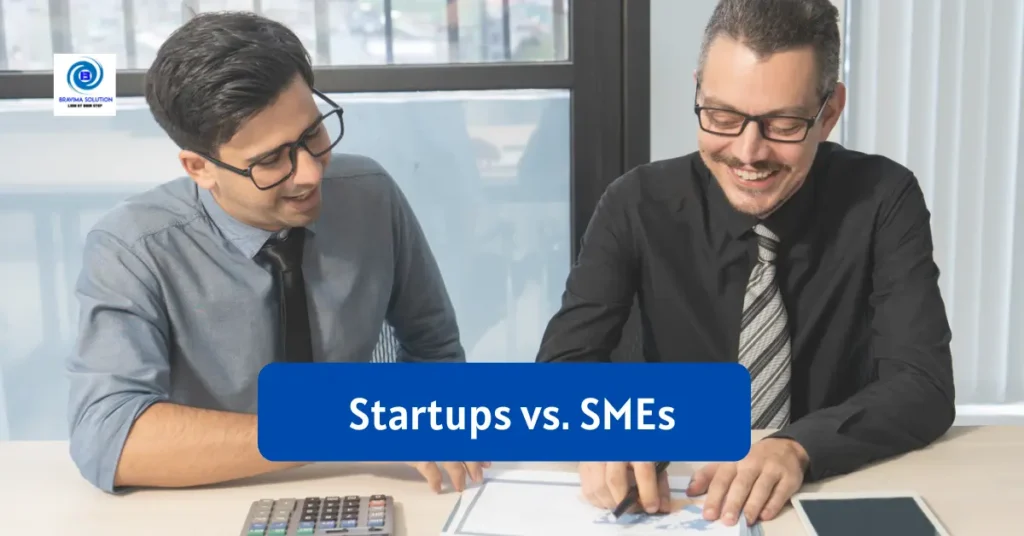
India’s business ecosystem is booming with a mix of ambitious startups and stable SMEs (Small and Medium Enterprises). While both contribute immensely to the economy, they are not the same — especially in terms of structure, purpose, funding, and scalability.
If you’re an aspiring entrepreneur or planning to apply for a business loan with the help of NBFC partners through Bravima Solution Pvt Ltd, knowing the difference between a startup and an SME is crucial.
What is a Startup?
A startup is a young company designed to grow fast and disrupt existing markets through innovation. Think of Zomato, Ola, Flipkart – they started as startups with bold visions and tech-driven models.
Key Features of Startups:
- Innovation-driven
- Scalable business model
- Usually tech-based or solving a unique problem
- Seeks angel investors, VCs, or seed funding
- Risk-taking mindset
- Operates in high-growth markets
- May not be profitable in the early stage
What is an SME (Small & Medium Enterprise)?
SMEs are traditional businesses with steady, long-term goals. They are the backbone of the Indian economy, contributing to over 29% of India’s GDP and employing millions.
Key Features of SMEs:
- Revenue-focused and stable
- Not necessarily scalable quickly
- More traditional business models (retail, manufacturing, services)
- Often bootstrapped or rely on bank/NBFC loans
- Less risky, but also slower growth
- Common in Tier 2 & Tier 3 cities in India
Comparison Table: Startup vs SME
| Factor | Startup | SME (Small & Medium Enterprise) |
| Business Goal | Rapid growth, market disruption | Stability, long-term profits |
| Risk Factor | High | Moderate to Low |
| Funding Source | Venture Capital, Angel Investors | Bank Loans, NBFC Loans, Self-funded |
| Growth Model | Exponential and scalable | Linear and steady |
| Innovation Level | Very high (often tech-driven) | Moderate, traditional operations |
| Revenue Focus | Long-term growth, not immediate profit | Monthly revenue and profit are priorities |
| Loan Preference | Venture debt, NBFC startup loan | NBFC SME loan, Working capital |
Example: A Startup vs an SME
Startup Example:
Rahul launches a fintech app that helps freelancers in India manage taxes and invoicing. His goal is to acquire 1 million users in 2 years and raise Series A funding. He needs funding for tech development and marketing.
SME Example:
Priya owns a packaging unit in Pune that supplies eco-friendly paper bags to local businesses. She needs a loan to buy new machinery and hire staff to meet growing demand.
➡ Both need funding, but their approach, risk appetite, and business models are completely different.
How Funding Differs for Startups and SMEs
Startup Funding Options:
- Seed Funding
- Angel Investors
- Venture Capital
- Startup-focused NBFC loans (through Bravima Solution)
- Government schemes like Startup India
SME Funding Options:
- NBFC Working Capital Loans
- Term Loans from Bravima Solution’s NBFC partners
- Mudra Loans
- MSME Development Funds
- Equipment/Asset Finance
Loan Eligibility Differences
| Criteria | Startup Loan | SME Loan |
| Years in Business | 0–3 years | 1–10 years |
| Profitability | Not necessary | Usually required |
| Credit Score | Founder’s credit is important | Business + Owner credit score matters |
| Documents Needed | Business Plan, MVP, Founder’s KYC | ITRs, GST filings, Financial Statements |
Bravima Solution’s Role in Helping Both
At Bravima Solution Pvt Ltd, we offer custom business loan solutions through our strong network of NBFC partners including:
- Bajaj Finserv
- Tata Capital
- HDB Financial Services
- Indifi
- NeoGrowth
We assist with loans for:
- Startups needing seed capital or tech development
- SMEs requiring working capital or equipment purchase
Which One Are You: A Startup or an SME?
Ask yourself:
- Are you building something innovative?
- Is your goal to scale fast or stay stable?
- Are you open to taking risks or prefer traditional growth?
Depending on your answers, your business fits into one of these categories, and that impacts:
- Your funding strategy
- Your marketing
- Your team building
- Your loan eligibility

Secure Your Business Funding – Apply in Minutes
Similar Blog
- Small Overdraft Loan for Business: A Smart Way to Manage Cash Flow
 Running a small business often comes with unexpected expenses and cash flow challenges. Whether it’s paying suppliers, covering salaries, or… Read more: Small Overdraft Loan for Business: A Smart Way to Manage Cash Flow
 - How to Reduce EMI on Business Loans in India: 7 Practical Ways
 If you’re running a business in India, managing your cash flow efficiently is crucial—and one way to ease financial pressure… Read more: How to Reduce EMI on Business Loans in India: 7 Practical Ways
 - What Is Business Turnover? Meaning, Types & Why It Matters
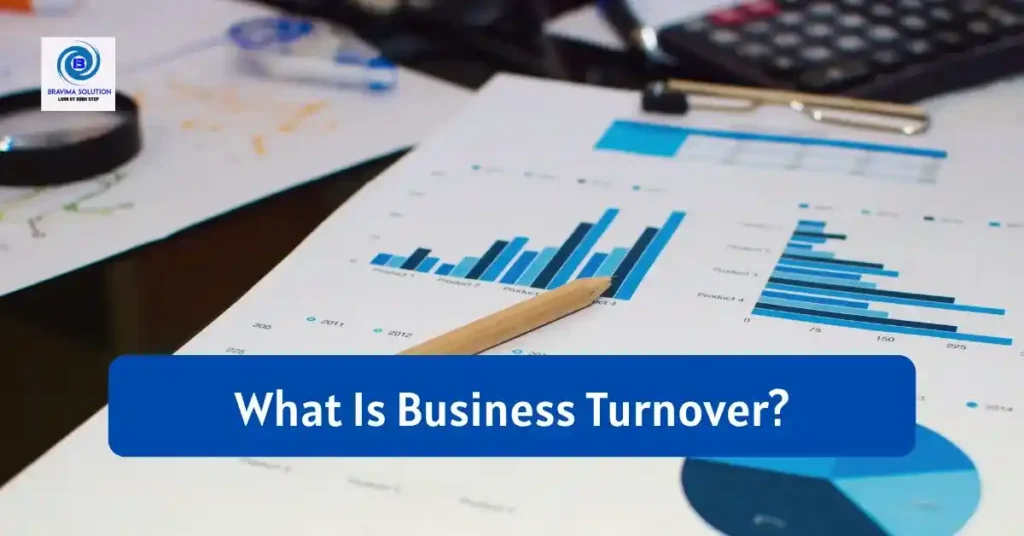 For any business—large or small—turnover is one of the most fundamental metrics. But what does it really mean, and why… Read more: What Is Business Turnover? Meaning, Types & Why It Matters
 - Small Business Cash Advances: A Flexible but Costly Funding Option
 When small businesses face urgent funding needs—like addressing seasonal inventory demands or unexpected expenses—they often turn to cash advances (including… Read more: Small Business Cash Advances: A Flexible but Costly Funding Option
 - Business Working Capital Loans: A Lifeline For Small Manufacturers in India
 In today’s competitive and dynamic industrial environment, small manufacturers often face cash flow gaps that affect operations, payroll, raw material… Read more: Business Working Capital Loans: A Lifeline For Small Manufacturers in India
 - What Are the Foreclosure Charges on a Business Loan?
 Foreclosing a business loan—i.e., paying it off before the end of its scheduled term—can be a smart move to reduce… Read more: What Are the Foreclosure Charges on a Business Loan?
